
Inside Your Body: What Really Happens in the First 30 Minutes of Assisted Lymphatic Therapy
Summary
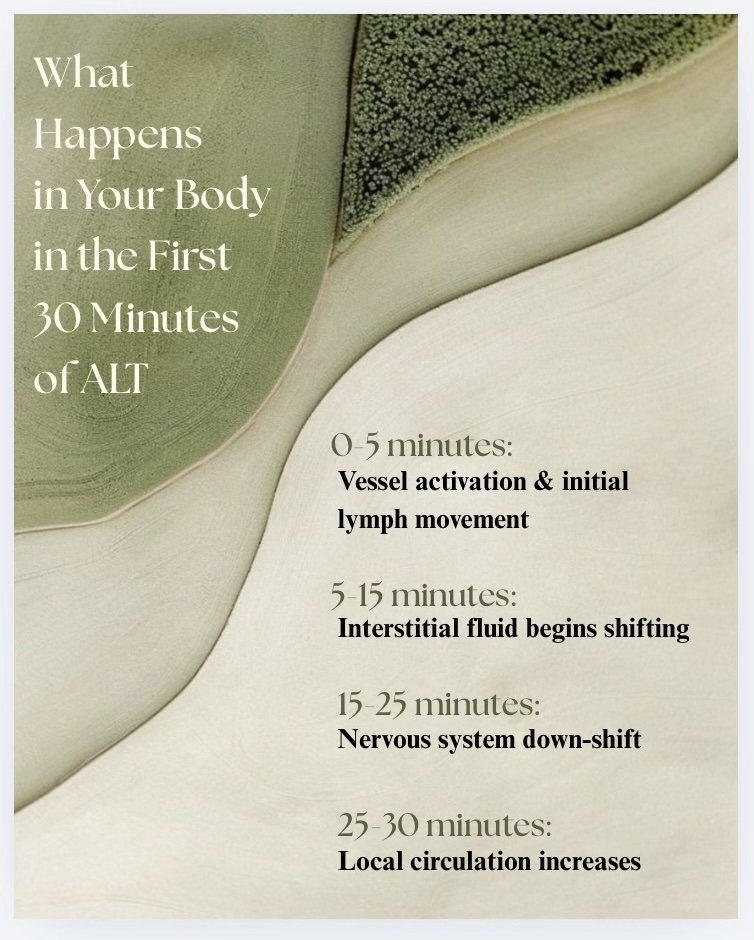
ALT enhances lymphatic vessel activity and opens fluid pathways.
Interstitial fluid begins to clear, reducing congestion.
Nervous system shifts toward relaxation and repair.
Local circulation improves, preparing tissues for better nutrient and oxygen exchange.
1. Lymphatic Vessel Activation and Enhanced Flow
The lymphatic system is a key partner to the cardiovascular and immune systems. Unlike blood vessels, lymphatic vessels do not have a central pump like the heart. Instead, lymph fluid is moved through a combination of intrinsic vessel contractions and external forces (muscle movement, breathing, gentle manual/assisted stimulation). Collecting lymph vessels contain smooth muscle cells and valves that rhythmically contract to push lymph forward and prevent backflow. (PubMed)
During Assisted Lymphatic Therapy, targeted stimulation encourages these vessels to activate more readily. This means lymph can move faster through the capillaries and collecting vessels toward the thoracic duct and back into the venous circulation. (PubMed)
This early activation is foundational: when lymph vessels open and contract more efficiently, fluid that has been stagnant in tissues begins to enter lymphatic pathways for transport and processing.
2. Movement of Interstitial Fluid and Detox Initiation
Interstitial fluid is the fluid that surrounds cells and tissues. It carries nutrients and waste products. Healthy lymph dynamics constantly return excess interstitial fluid to circulation, preventing swelling and stagnation. (PubMed)
In the first minutes of an ALT session, this fluid begins to shift out of congested tissues and into open lymphatic pathways. Excess proteins, inflammatory byproducts, and metabolic waste — previously “stuck” in the interstitium — are nudged into motion. Once in the lymphatic network, these materials will be filtered through lymph nodes and eventually processed through the liver, kidneys, and gut, activating the body’s natural detox pathways.
This is not forceful removal; it is physiologically supported flow that mirrors how the lymphatic system normally operates when unblocked and responsive.
3. Nervous System Modulation Toward Repair
While the lymphatic vessels respond mechanically to stimulation, another key effect is seen in the nervous system. The lymphatic system is closely tied to autonomic regulation — particularly the balance between sympathetic (fight-or-flight) and parasympathetic (rest-and-digest/repair) states.
Gentle, rhythmic stimulation characteristic of ALT encourages a parasympathetic shift. This shift:
slows heart rate
promotes relaxation
reduces cortisol levels
supports immune and hormonal signaling
This state is sometimes called “repair mode,” because the body’s priority transitions from managing stress to facilitating healing and regulation. This isn’t just subjective relaxation — nervous system modulation impacts endocrine and immune communication pathways.
4. Local Circulation Begins to Improve
As lymph congestion decreases, tissues experience reduced pressure and improved microcirculation. In healthy functioning tissue, good circulation means oxygen and nutrient delivery is optimized and waste removal becomes more efficient.
Reduced tissue pressure — due to lymph and interstitial fluid movement — allows blood vessels to dilate and improves localized blood flow. This improvement supports tissue function and may reduce pain or stiffness commonly associated with stagnation. Improved circulation also feeds back into better lymphatic function, as the lymphatic system benefits from the dynamic interplay between fluid exchange and tissue pressures.
Closing
Understanding what happens inside your body during the first 30 minutes of an Assisted Lymphatic Therapy session gives insight into why this modality is more than a momentary experience. It initiates a cascade of physiological changes that lay the groundwork for lasting improvements in fluid balance, immunity, circulation, and nervous system regulation.
If you’re curious how your own body responds — and what you might feel during a session — scheduling an initial session is the best way to begin.
Sources & Further Reading
Transport and Immune Functions of the Lymphatic System — PubMed (PubMed)
Lymphatic drainage function and immune implications — PubMed (PubMed)
Mechanics of Lymphatic Pumping — PubMed (PubMed)
Lymphatic flows and physiology — PubMed (PMC)
Functional unit of the lymphatic system — Journal of Vascular Research (Karger Publishers)